 Skip-the-line available
 The History of Château du Haut-Kœnigsbourg
From a 12th-century stronghold to ruin in 1633 and a stone-by-stone rebuild for Kaiser Wilhelm II between 1900 and 1908.
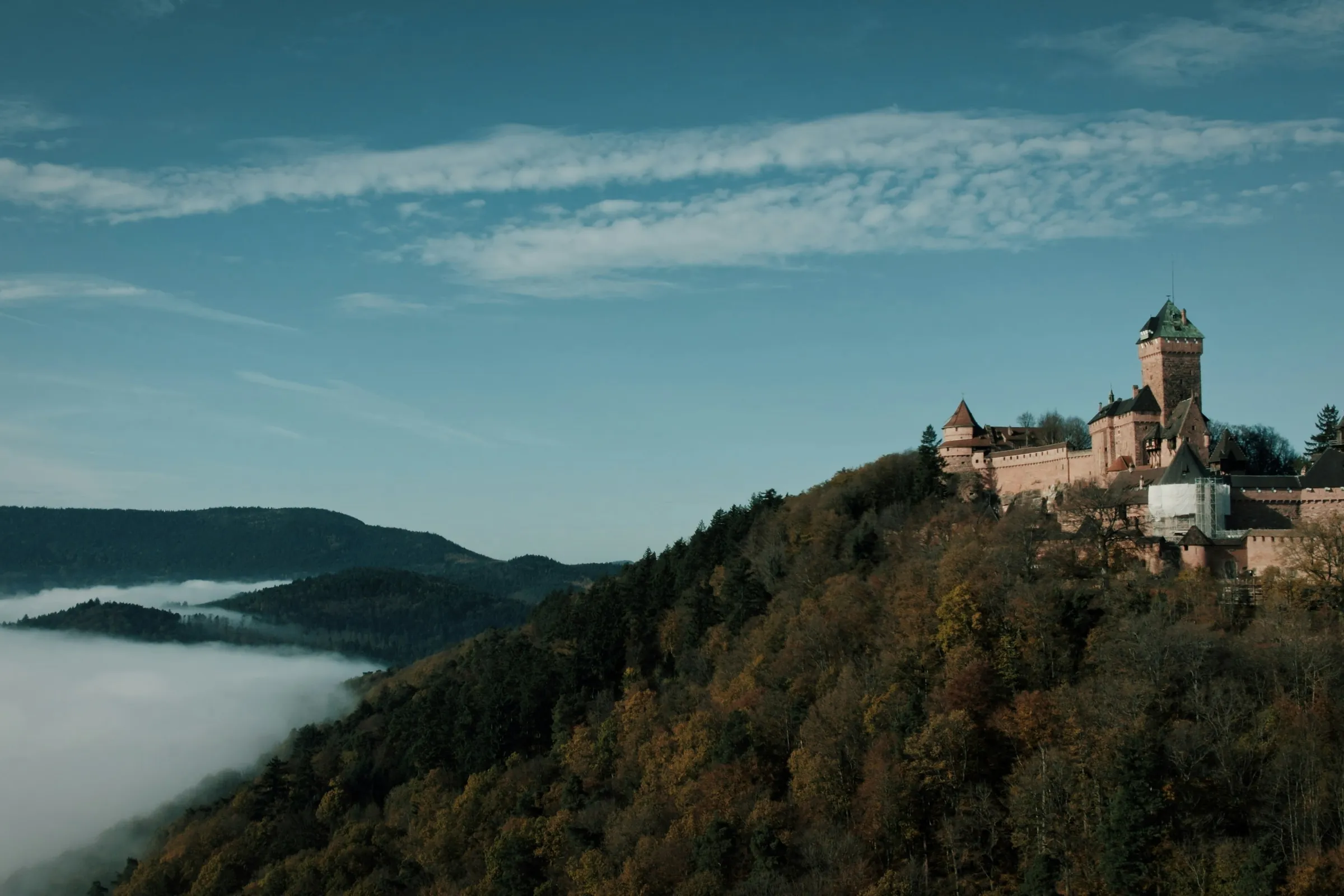
Haut-Kœnigsbourg is two castles in one: a genuine medieval fortress with centuries of history, and an extraordinary early-1900s reconstruction of what such a fortress might have been. Understanding that double identity is the key to appreciating the visit — knowing which stones are medieval and which are turn-of-the-century, and why a German emperor rebuilt an Alsatian ruin just before the First World War. This guide tells the story, from the fortress's first record in 1147 to its ruin in 1633, its three centuries as a romantic ruin, and the reconstruction that gave it the form you walk today.
A Medieval Stronghold on the Heights
The castle is first recorded in 1147, when it already stood as a fortress on its commanding spur of the Vosges at around 755 metres, watching over the routes through the Alsace plain. Its position made it strategically valuable, and across the Middle Ages it was held, contested and rebuilt by a succession of powers, expanded and adapted as the technology of siege and defence changed. By the later medieval period it had grown into a substantial fortress, and the great round artillery bastion reflects its adaptation to the age of gunpowder.
Such a prominent stronghold inevitably drew conflict. The castle was besieged and damaged more than once over the centuries, repaired and re-garrisoned as control of Alsace shifted between rival lords and powers. Its medieval life as a working fortress continued until the upheavals of the 17th century, when the Thirty Years' War swept through the region and brought the castle's active history to a violent end.
Ruin in 1633 and Three Centuries of Decay
In 1633, during the Thirty Years' War, the castle was besieged by Swedish forces, taken, and burned. Stripped and damaged, it was abandoned, and for nearly three hundred years it stood as a ruin on the skyline — walls crumbling, vaults collapsing, vegetation reclaiming the courtyards. Like many such ruins it became a romantic landmark, admired from below and visited by the curious, but left to the slow work of weather and time on the exposed summit.
The castle's fate was bound up with the history of Alsace itself. After the Franco-Prussian War of 1870–71 the region was annexed by the newly unified German Empire, and the ruined fortress on the frontier took on symbolic weight. In 1899 the town of Sélestat, which owned the site, presented the ruin to the German Kaiser Wilhelm II — setting in motion the most dramatic chapter in the castle's story.
Bodo Ebhardt's Reconstruction, 1900–1908
Kaiser Wilhelm II saw in the ruin a chance to restore a symbol of imperial heritage on the German Empire's western frontier, and he entrusted the work to Bodo Ebhardt, the foremost castle scholar and architect of his day. Ebhardt surveyed the ruins, studied the surviving fabric and comparable fortresses, and from 1900 to 1908 rebuilt the castle on its medieval foundations. Where evidence survived he followed it closely; where it did not, he reconstructed a plausible late-medieval castle, complete with keep, drawbridge, furnished halls, an armoury, kitchens, a chapel and the great bastion.
The result, inaugurated in 1908, is an idealised whole rather than a literal restoration of any one period — which is exactly what makes Haut-Kœnigsbourg unusual and fascinating. It is at once a genuine medieval site and a remarkable document of how the early twentieth century imagined the Middle Ages. After the First World War the castle passed to the French state, and it later came under the management of a regional public authority, opening to the public as one of the most visited monuments in Alsace.
La Grande Illusion and the Castle on Screen
Haut-Kœnigsbourg's dramatic silhouette has long made it a magnet for filmmakers, and its most famous screen role came in 1937, when Jean Renoir filmed scenes of his celebrated anti-war masterpiece La Grande Illusion at the castle. The fortress stood in for a First World War prison stronghold, and its brooding, commanding presence suited the film's themes perfectly. The association has stayed with the castle ever since and is part of its cultural fame.
Beyond cinema, the castle is simply one of the defining images of Alsace — its fortress profile on the Vosges ridge above the vineyards appears on countless posters, postcards and book covers. Today, drawing more than half a million visitors a year, it stands as both a major heritage monument and a beloved landmark, its layered history of medieval fortress, romantic ruin and early-1900s reconstruction visible at every turn as you walk through it.
Frequently asked
How old is Château du Haut-Kœnigsbourg?
The fortress is first recorded in 1147, so its origins lie in the high Middle Ages. The castle you visit today, however, is largely a reconstruction carried out between 1900 and 1908 on the medieval foundations.
Why was the castle a ruin?
It was besieged by Swedish forces and burned in 1633 during the Thirty Years' War, then abandoned. It stood as a ruin for nearly three centuries until its reconstruction began in 1900.
Who rebuilt the castle, and when?
The architect and castle scholar Bodo Ebhardt rebuilt it between 1900 and 1908 for the German Kaiser Wilhelm II, after the town of Sélestat gave him the ruin in 1899. It was inaugurated in 1908.
Why did a German emperor rebuild a French castle?
At the time Alsace was part of the German Empire, annexed after the Franco-Prussian War of 1870–71. Kaiser Wilhelm II saw the ruin as a symbol of imperial heritage on the frontier and had it restored. Alsace returned to France after the First World War.
Is the castle authentic or a reconstruction?
Both. It is a genuine medieval site, but the standing castle is Ebhardt's 1900–1908 reconstruction — following the evidence where it survived and reimagining a plausible late-medieval fortress where it did not. That double identity is part of what makes it fascinating.
Was Haut-Kœnigsbourg in a film?
Yes — Jean Renoir filmed scenes of his celebrated 1937 anti-war film La Grande Illusion at the castle, with the fortress standing in for a First World War prison stronghold. It is one of the castle's claims to fame.